
What happens when a woman makes a decision about her own body and the people closest to her treat it as a personal offense?
That question sits at the center of The Vegetarian by Han Kang. I picked up this short novel while researching Nobel Prize winners, curious about an author whose work had earned such recognition. I wanted beautiful writing and a unique story. I certainly got something unique, although I’m not sure I was prepared for just how disturbing it would be.
When Yeong-hye decides to stop eating meat after experiencing violent dreams, her seemingly simple act of independence sends ripples through her marriage and family. What follows is an increasingly uncomfortable exploration of control, bodily autonomy, family expectations, and the ways people respond when someone refuses to behave as expected.
The writing is haunting, the imagery is vivid, and the horror is genuinely horrifying. But did I love it? That’s a more complicated question.
*Spoilers will be hidden and labelled so you can choose to read or skip.
This post may contain affiliate links. If you click on them and make a purchase, I may earn a small commission at no extra cost to you. As an Amazon Associate I earn from qualifying purchases.
Before Reading:
Where did I hear about this book? Researching Nobel Prize winners
Curiosity or Awareness: Curiosity
Would I read it if no one was talking about it? Yes
What I want from this book: I want amazing writing and a unique story
Hype Meter
Goodreads: 3.65 | StoryGraph: 3.63 | Fable: 3.6
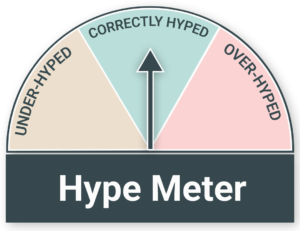
My Take: Correctly-hyped. This one is polarizing; some love it, some hate it.
Judge The Vegetarian By Its Cover
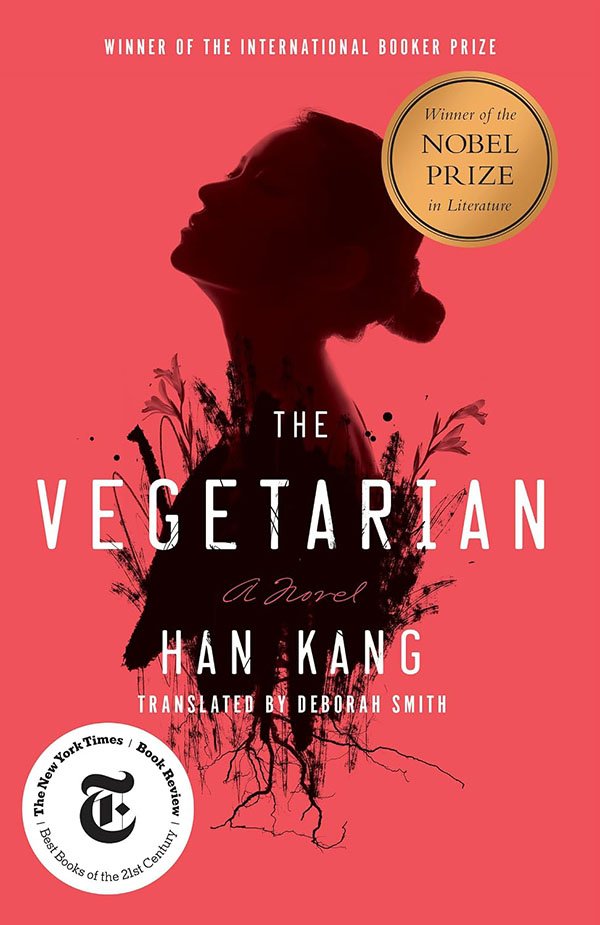
The cover of The Vegetarian is simple and elegant. The shoulders-up bust of a Korean woman with her chin elevated, surrounded by vegetation, nearly in silhouette, is dynamic while remaining poised and still.
Color Story
Again, the cover relies on simplicity. A solid coral background with a monotone black illustration and white text. Clean. Focused. Elegant. Eye-catching.
Typography Notes
Tall, lean, and widely spaced, that font styling feels luxurious. The slightly rounded edges make it more approachable.
Genre Signals
One would not suspect this to be a horror novel. It appears more like an emotional character study. If I were not already aware, I would have guessed this to be literary fiction.
Hidden Details
Nothing to report
Mood Check
From the cover, I would have guessed this to be a sad but hopeful book.
Beyond the Dust Jacket
The Vegetarian is divided into three parts: The Vegetarian, The Mongolian Mark, The Flaming Trees. Each is told by a different narrator connected to the story.
There are no other major chapter breaks, but there are scene breaks indicated with simple glyphs.
Did the design affect whether I bought the book?
I bought the book more because I was aware of the author. I became curious when researching Nobel Prize winners.
Story Snapshot
In Short
After disturbing dreams of blood and violence, a woman renounces meat, triggering a chain of increasingly grotesque events as her family attempts to control her growing estrangement. Winner of the International Booker Prize.
From the Publisher
FROM HAN KANG, WINNER OF THE 2024 NOBEL PRIZE IN LITERATURE
“[Han Kang’s] intense poetic prose . . . exposes the fragility of human life.”—The Nobel Committee for Literature, in the citation for the Nobel Prize
A NEW YORK TIMES BESTSELLER
WINNER OF THE INTERNATIONAL BOOKER PRIZE
ONE OF THE NEW YORK TIMES’S 100 BEST BOOKS OF THE 21ST CENTURYONE OF THE GUARDIAN’S 100 BEST NOVELS OF ALL TIMEA
KIRKUS REVIEWS BEST FICTION BOOK OF THE CENTURY
ONE OFBOOK RIOT’S BEST HORROR BOOKS OF THE CENTURY
“Ferocious.”—The New York Times Book Review (Ten Best Books of the Year)
“Both terrifying and terrific.”—Lauren Groff
“Provocative [and] shocking.”—The Washington Post
Before the nightmares began, Yeong-hye and her husband lived an ordinary, controlled life. But the dreams—invasive images of blood and brutality—torture her, driving Yeong-hye to purge her mind and renounce eating meat altogether. It’s a small act of independence, but it interrupts her marriage and sets into motion an increasingly grotesque chain of events at home. As her husband, her brother-in-law and sister each fight to reassert their control, Yeong-hye obsessively defends the choice that’s become sacred to her. Soon their attempts turn desperate, subjecting first her mind, and then her body, to ever more intrusive and perverse violations, sending Yeong-hye spiraling into a dangerous, bizarre estrangement, not only from those closest to her, but also from herself.
Celebrated by critics around the world,
The Vegetarian
is a darkly allegorical, Kafka-esque tale of power, obsession, and one woman’s struggle to break free from the violence both without and within her.
A Best Book of the Year:
BuzzFeed, Entertainment Weekly, Wall Street Journal, Time, Elle, The Economist, HuffPost, Slate, Bustle, The St. Louis Dispatch, Electric Literature, Publishers Weekly
Lines I Highlighted
Before my wife turned vegetarian, I’d always thought of her as completely unremarkable in every way.
Characters I Followed Into Battle
Yeong-hye is “the vegetarian,” which one might argue makes her the main character. However, her story is told by her husband, her brother-in-law, and her sister. What we know about her, we learn from other people’s perspectives rather than her own internal monologue. Oddly, this makes her a sympathetic character in ways you might not expect. The Vegetarian acts as somewhat of a character study of this small group of people. While there are character developments, there is no personal growth.
Lines I Highlighted
I would be unable to conceal a feeling of abhorrence when I looked across at her.
Writing Style Notes
Interestingly, the only time the reader sees from the supposed main character’s point of view is when she is dreaming. Most of her experience is filtered through what her husband and family observe and think.
The body horror elements are visceral and disturbing, even while describing things that aren’t that awful. The language is very specific and powerfully chosen.
Chapters are extra long. There are only three, divided by point of view. There are some scene breaks marked with glyphs, but for readers who prefer natural stopping points, it’s not especially comfortable.
Lines I Highlighted
She’s a good woman, he thought. The kind of woman whose goodness is oppressive.
Themes Living Rent-Free In My Head
- Bodily autonomy vs. personal safety: where is the line?
- Cultural/societal standards and family dynamics
- Mental illness
- People are far more concerned with themselves than how their behavior affects others.
Lines I Highlighted
What threw him was the way that his brother-in-law seemed to consider it perfectly natural to discard his wife as though she were a broken watch or household appliance.
What Landed For Me
What Worked:
- Interesting peek into South Korean socio-cultural norms and family dynamics
- Haunting prose elicits vivid imagery
- The horror was horrifying
What Didn’t Fully Click:
- The ending was abrupt and felt unfinished.
- It felt a little like the point was missing, and I should all go look for it, but I didn’t really feel compelled to do so.
Overall:
The Vegetarian was not for me, but I think I can see why others might like it. Mabye?
Lines I Highlighted
It seemed enough to her to just deal with whatever it was that came her way, calmly and without fuss. Or perhaps, it was simply that things were happening inside her, terrible things, which no one else could even guess at, and thus it was impossible for her to engage with everyday life at the same time.
Intentional Reading Reflection
In the beginning, I was so angry on Yeong-hye’s behalf. Her husband and family were so much more concerned with how her behavior reflected on them than on her own ability to make choices! Later, of course, it became clearer that there was something deeper happening to Yeong-hye than just making a choice not to eat meat. Regardless, it begs the question: if they had treated her differently, would the outcomes have also been different?
It is also disturbing that Yeong-hye isn’t a primary narrator. We are left to determine what we think this person is thinking and feeling from others’ interpretations of her behavior. Putting the audience squarely in the same camp as those who judge what is best for her with little consideration for her own thoughts and desires.
As a new-to-horror reader, I definitely felt unsettled by the story. Having little to compare it to, I can’t make a lot of comparisons, but this short novella packed a punch at least for my sensibilities. I found many of the scenes disturbing and much of the plot uncomfortable.
The end confused me. It seemed like it was building toward something, but it just stopped. Nothing felt concluded or wrapped up. You are left with far more questions than answers. I imagine that was probably the point. Han Kang makes you sit in your discomfort and think about why you feel that way.
The Vegetarian was undeniably a well-written book, but I’m not sure I’ll be going back for seconds on Han Kang (despite having Human Acts in my TBR).
Lines I Highlighted
Time was a wave, almost cruel in its relentlessness as it whisked her life downstream, a life she had to constantly strain to keep from breaking apart.
Cover Promise Rating
Did the cover make promises the story actually kept?
No. The cover of The Vegetarian led me astray! While technically it makes sense after having read the book. It does not prepare a reader for the gruesome interior.
Lines I Highlighted
She’d been unable to forgive her for soaring alone over a boundary she herself could never bring herself to cross, unable to forgive that magnificent irresponsibility that had enabled Yeong-hye to shuck off societal constraints and leave her behind, still a prisoner. And before Yeong-hye had broken those bars, she’d never even known they were there.
Final Verdict
Read if you like:
- Psychological Horror Fiction
- Unsettling stories
Skip if you dislike:
- Disturbing body horror, medical imagery, non-consensual sex acts
- Abrupt endings without a sense of conclusion.
Lines I Highlighted
Now, with the benefit of hindsight, In-hye could see that the role that she had adopted back then of the hard-working, self-sacrificing eldest daughter had been a sign not of maturity but of cowardice. It had been a survival tactic.
Reading Debris
I read The Vegetarian to fulfill the Playing Card Reading Challenge prompt: Read a translated book. It would also fulfill: Read a book under 200 pages. And, for me at least, read a book outside your comfort zone.
Winner of the International Booker Prize
Han Kang is the 18th woman to be awarded the Nobel Prize for Literature (2024).
Your Turn
Have you ever made a decision that upset everyone in your life? How did you deal with the fallout?
May your life be as full as your bookshelf and as long as your TBR list.
Happy Reading!
Whether the things you perceive are there or not, they are real to you.
“Hallucinations” lined, 120-page, paperback journal.

0 Comments