

Phantasma
Phantasma has been everywhere lately — moody posts, swooning book-girlies, and a cover that practically dares you to pick it up. I did. And while the gilded skulls and gothic romance vibes delivered a look, the story didn’t quite live up to the atmosphere it promised. This dark fantasy romance is rich in aesthetic, concept, and angst — but sometimes style outweighs substance. If you’re here for the mood, you’ll love it. If you’re here for depth… well, you might find yourself skimming between the sparkles.
This post may contain affiliate links. If you click on them and make a purchase, I may earn a small commission at no extra cost to you. As an Amazon Associate I earn from qualifying purchases.
Hype Report
Goodreads readers have this one rated 4.06 stars. Over-Hyped.
Aesthetic

The Cover
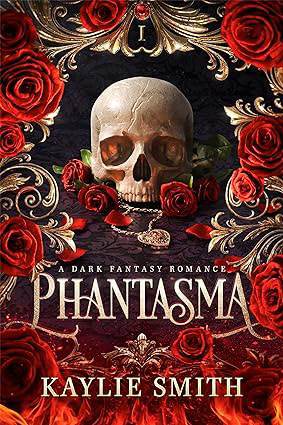
The cover of Phantasma grabs your eye and doesn’t let go! The imagery and palette easily identify the genre as dark fantasy romance. The typography is at once elegant and mysterious yet easy to read. The texture and lighting treatment of the title help it to stand out from the other elements. Richly textured, the cover art matches elements described in the book – the gilding, brocades, roses, fire, and locket. The skull serves as a memento mori and a key visual cue for the genre.
Interior
I read Phantasma as an ebook, and the formatting was clear and easy to read. No fluff.
Did the design affect whether I bought the book?
Yes! I have been seeing this book everywhere, lots of hype (I’m looking at you Bookstagram!). Ultimately, the cover made me buy it. Its promise of what lies within was too much to resist.
Summary
In Short
Necromancer, Ophelia, enters Phantasma – a devil’s mansion multi-level death competition – to save her sister; finds self and love along the way.
From the Publisher
Welcome to Phantasma. There are only two rules to the game: Stay alive. And don’t fall in love.
When Ophelia’s sister disappears, there is only one way to save her. Ophelia must enter Phantasma, a deadly contest inside a haunted mansion, and claim its prize—a single wish.
Phantasma is a maze of twisting corridors and lavish ballrooms, of demons and temptations. Ophelia will face nine challenges, each more dangerous than the last. There can only be one winner, and the other contestants will stop at nothing to eliminate their rivals.
Every day, the house creates new monsters. But just as Ophelia’s fears threaten to overwhelm her, a mysterious stranger offers her a bargain.
Charming, arrogan,t and infuriatingly attractive, Blackwell claims he can guide her through the lethal trials ahead. All he asks in return is ten years of her life.
Ophelia knows she shouldn’t trust him. Blackwell doesn’t seem dangerous, but appearances can be deceptive. Worse still, she feels a dark and irresistible attraction drawing them closer and closer.
Her life is on the line. But in Phantasma, the only thing deadlier than losing the game is losing your heart . . .
Character Analysis
Ophelia, Phantasma‘s female main character (FMC), breaks some stereotypes of the average FMC. She has obsessive-compulsive disorder (OCD) and classic firstborn daughter tendencies. Props for the mental health disorder representation! On the other hand, she was a little hard to relate to. While they were spelled out, it didn’t always seem like her motivations had much emotional weight.
Blackwell, Phantasma‘s male main character (MMC), was conveniently amnesic for the majority of the book. His charm (often read as egotism) and devotion to Ophelia (which seemed 55% self-serving) catalyze falling in love. Protecting his investment and being good at sex seem like tenuous threads to build a forever on.
Despite being told that the FMC and several other contestants are in their early 20s or later, they all seemed much younger. This is believable as naïveté in Ophelia, who doesn’t get out much, but wears a little thin over the course of Phantasma.
“In a different life, in a fair one, I would’ve kept you until my eternal soul withered away to dust,” he vowed to her.”
Writing Style
I can’t exactly explain here, but it felt like the author was trying very hard. Instead of an effortlessly flowing text, some passages of Phantasma felt forced. As if the text were written, then gone over with a thesaurus in hand. There isn’t anything wrong with that, but the word usage didn’t seem natural or in keeping with the character’s voice.
On the other hand, the plot and pacing of Phantasma were clearly thought through and steady. Plenty of suspense and drama to be had along with a heaping pile of sex (it is a devil’s mansion after all).

Themes
Phantasma is a coming-of-age type of story. Ophelia is dealing with the sudden loss of her mother, being the new head of the household, and the carrier of the family magic all at once. Finding that her sister has entered a dangerous competition to save them from destitution, she must act. Pushed into a pressure cooker of a situation, Ophelia has to decide who she is, what she values, and how far she’ll go to protect what and who she loves.
Living with OCD, Ophelia must also confront her personal demons – not just those who run Phantasma.
Critical Evaluation
Ophelia experiences a lot in the story of Phantasma. Unfortunately, the emotional resonance fell a little flat. The OCD allowed the “Shadow Voice” to be personified as almost an alter ego that she battled against. Instead of a conflicted inner monologue with this added layer of pressure, we see a regular monologue, Ophelia as “good” and the shadow voice as “bad.” I would have preferred Ophelia to confront the fact that she was angry with her mother for dying and her sister for many crimes, but still loved them enough to take on Phantasma. Instead, she is duty-bound but plagued by a controlling inner voice, where we don’t get the nuances of human emotion.
A great number of words talk about Blackwell’s clothing, and his energy is often referenced, but we don’t know what Blackwell looks like beyond tall, white hair, and “emerald” eyes. As a reader, I can’t quite put my finger on what the FMC likes about the MMC. They seem trauma-bonded more than devoted.
SPOILERS
Planned or Plot Holes?
Smith pointedly calls out the key devils’ “devil’s marks,” but chooses not to reveal Blackwell’s mark. This seems like an oversight in the wrap-up.
What exactly are Sinclair’s motivations? Is he undermining or helping Blackwell? On his level, he gives Ophelia the True/False “Ophelia has kissed a devil.” He knows Blackwell is a devil and that Ophelia did not know. So if he tried to undermine Blackwell, wouldn’t he have let her get this wrong? Instead, he kisses her just before the level so she can get the answer right and go on in Phantasma under the guise of making Blackwell jealous.
The rule in Phantasma is fall in love at your own risk, but when we see the example of that play out (Luci) the consequences only come when the love is admitted out loud. Granted, the levels forced her hand, but would she have still been cursed if she’d lied?
Personal Opinion
Phantasma is an interesting concept, but the execution left something to be desired. I will probably not continute with the second book.
Recommendation
If you are a vibes-only reader who likes dark fantasy romance with some spice, then this fits the bill. If you are looking for something more deeply meaningful that will stick with you, it’s a pass.
Notes
Phantasma is the first in a duology. The second book is Enchantra.
Do you read Dark Fantasy Romances? What are your favorites? Tell me in the comments!
Buy This Book
May your life be as full as your bookshelf and as long as your TBR list.
Happy Reading!



0 Comments