

For the Historical Fiction Enthusiast
What if the most powerful player in medieval Europe was a woman history almost forgot?
That’s the provocative question behind The Widow Queen, a sweeping political drama rooted in real dynasties and ancient kingdoms. I picked up this book knowing nothing about the time period, the author, or even the historical figures—but the design, the premise, and that magnetic main character pulled me in. Let’s talk about whether this one lives up to the hype.
Hype Report
Goodreads ranks this book. 3.98 stars. It was very good so I am weighing in with appropriately-hyped.
This post may contain affiliate links. If you click on them and make a purchase, I may earn a small commission at no extra cost to you. As an Amazon Associate I earn from qualifying purchases.
Aesthetic

The Dustjacket
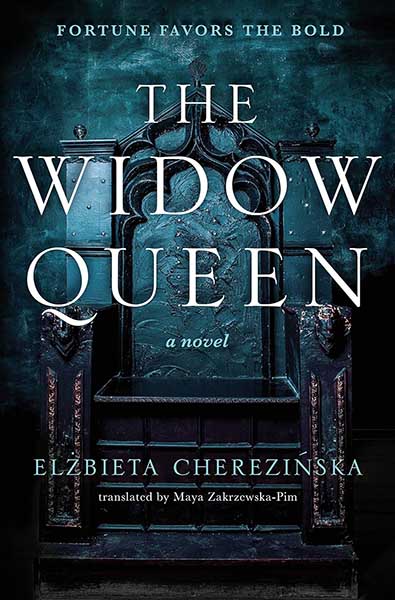
Beautiful, moody image of a medieval era throne. Typography that is regal and luxurious. Excellent visual hierarchy gives the novel’s title its due, and everything else takes a back seat. Loving the uncluttered appearance. The tagline “Fortune Favors The Bold” is apt, and correctly placed and sized for this cover.
Interior
There are many maps in the front (I actually looked at them from time to time). The back of the book features historical dynasty family trees that extend beyond the novel’s framework in both directions. Part title pages are regal-looking and delineate “eras” throughout the book. The text is well laid out and readable. Chapter titles are numbered, but also label the country that you are “in” for each segment which is helpful as the text does jump around quite a bit.
Did the design affect whether I bought the book?
Yes, I absolutely picked this book up because the cover was calling out to me. This is not a time period that I have any experience with, so the content was a first for me. Nor had I read anything previously from this author. The decision to buy was based solely on the cover and the description.
Summary
In Short
One young woman, bound by duty, haunted by the desire for love, and confined by the societal expectations of gender and class, navigates the tumultuous political waters of Northern Europe in the tenth century to rise to unprecedented heights.
From the Publisher
Elzbieta Cherezinska’s The Widow Queen is the epic story of a Polish queen whose life and name were all but forgotten until now.
In this epic saga of family, love, and war, we meet a battle-tested exile returning to claim his rightful throne; a bloodthirsty prince hungering for his father’s crown; an honorable Viking leader thrust into the politics of nobility; and a young woman withthe power to raise or ruin the fates of them all.
The bold one, they call her—too bold for most.
To her father, the great duke of Poland, Swietoslawa and her two sisters represent three chances for an alliance. Three marriages on which to build his empire.
But Swietoslawa refuses to be simply a pawn in her father’s schemes; she seeks a throne of her own, with no husband by her side.
The gods may grant her wish, but crowns sit heavy, and power is a sword that cuts both ways.
Dedication:
“To all the anonymous, forgotten princesses. The nuns, wives, mothers, and rulers about whom history is silent. The girls marked in biographies of dynasties with a sad. “N.N.””
Character Analysis
There are a lot of characters in The Widow Queen. They are named after historical people and spelled accordingly for their languages and times. This makes the reading experience a little bit difficult for people who are not familiar (like me!) In more than one instance, a person has multiple names. Beyond the confusion of naming, I would say that the characters are complex and well-rounded. There are as many things to dislike as there are to like about any individual. Choices are made, lives lived, and characters develop and change over time. Character growth is done in a way that feels very organic and true to life.

SPOILERS
I found the development of mutual respect and (maybe) love between arranged-marriage individuals to be really interesting. For instance, even though Swietoslawa must marry King Eric to form an alliance for political gain, and she doesn’t care for him at all at first, by the time he dies, she has grown to care for him in a way that she could not have expected. Or the way that Astrid both looks down on and yet is very attracted to her husband, while he slowly falls very deeply in love with her.
“She and Eric were connected now, as if by an invisible thread, whether she loved him or not.”
Writing Style
The writing is third person, so the reader stays at arm’s length from the characters. While this might be off-putting for those who like to feel the book, here it is almost necessary to understand the complex political motivations and maneuvering that happen throughout the plot. The pace is consistent through the book – not plodding, but certainly not brisk. Overall, I think that the style complements the complexity. If the pace were quicker, the reader might miss important plot points or carefully weaved allusions and foreshadowing.
“Even if she had angered the local gods, she told herself, she could not be frightened by a power she didn’t believe in.”
Themes
Power is the main driver of the majority of the characters and the plot as a whole in The Widow Queen. It is a political drama that happens to play out in 10th-century Northern Europe. Themes of family loyalty, duty, and to a degree, different types of love give dimension to this tale of strategy and will. There is also a tension brought by the transition from “old gods” to “new god” as Christianity begins to spread through pagan lands. A great light is thrown on the political and social importance of women in this time and place.

“They stopped chanting, they fell silent. They approached her, one by one. And they kissed the sword that dripped with blood.”
Critical Evaluation
The Widow Queen digs deep into the way that women influenced the development of the countries in Northern Europe in the 900s and the spread of Christianity at that time. While the story is fiction, it brings to life real names that did exist in those places at that time. It highlights cultural differences and the way that individuals can influence society at large. Cherezinska walks a tightrope between historical fact and fictionalization of real people and does it in a way that is highly believable. There are elements that, due to the religious undertones of the text, appear in a sense “magical.” Some have visions and where unexplainable things happen (like a person not being able to speak when they get to a point in their sentence that might be derogatory).
“Two deaths threatened the balance of the three northern kingdoms. The word of a single woman could bring the balance back.”
Personal Opinion
The Widow Queen is the first in a duology. The next book is called The Last Crown, and I am excited to see how the story evolves. I found myself forming opinions about characters, and then those opinions changing over time based on their actions. I love it when I can see the nuance of a character, not all love/hate, but something more complicated and real. Being wholly unfamiliar with the historical context of this book, I found it educational. My interest is sparked for other Viking era historical fiction (or just fiction) where I might not have gone down that path before reading The Widow Queen. An aspect that the romance reader in me adores is the otherwise “hard” men who soften considerably around the woman they love. It is also wonderful that they love the woman who is sharp, intelligent, and much bolder than societal expectations might allow.
“He’d only truly felt like a king with her at his side, drinking in the worship, desire, and fear of his chieftains, who glanced at his queen cautiously.”
Recommendation
This is a great read for historical fiction lovers. If you are into Vikings, political strategy, and intrigue, or learning about the lives of women in other historical contexts, this is for you.
However, it may be a difficult entry point to the genre for other genre readers, mainly due to the many foreign names and places. I say that, but caveat it with – if you read fantasy and in many cases sci-fi, you already overcome this when you visit those other fictional worlds. The slower pace may also be difficult for readers who have difficulty maintaining interest over a 500-page book.
Notes
The Widow Queen is was first released in Poland in 2016, the translated version published in the US in 2021. Both writer, Elzbieta Cherezinska, and translator, Maya Zakrzewska-Pim are from Poland.
I imagine this would be a good audiobook for the correct pronunciations and accents alone! Has anyone listened to The Widow Queen as an audiobook that can verify?
May your life be as full as your bookshelf and as long as your TBR list.
Happy Reading!

0 Comments